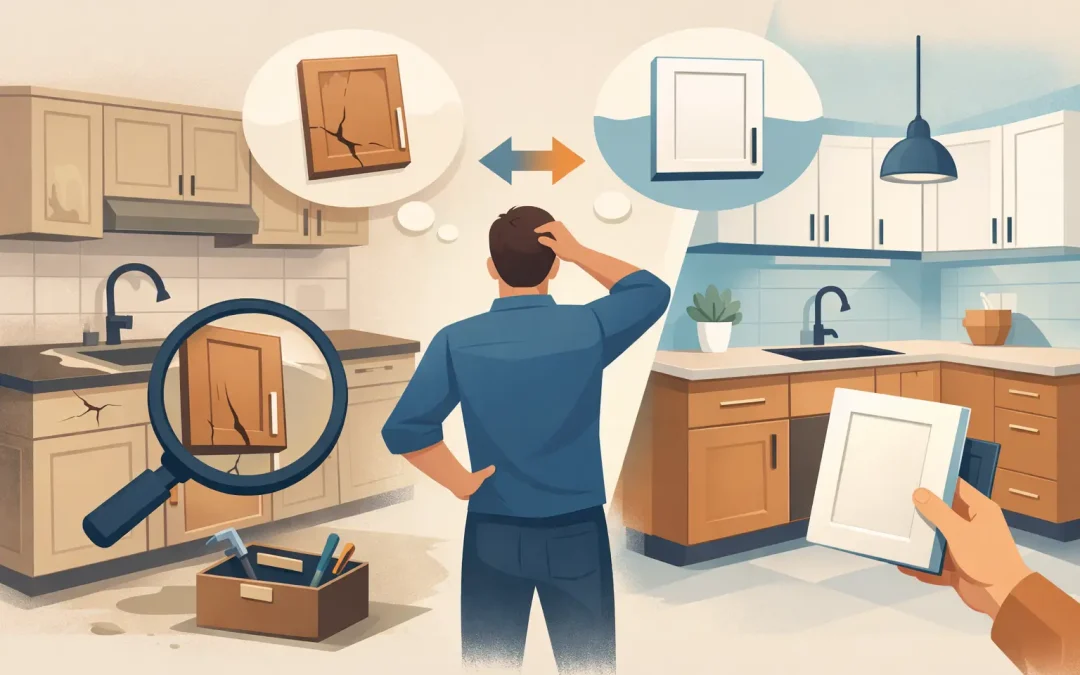
A cupboard door that no longer closes properly can be frustrating. But when several doors are sagging, drawers stick, surfaces are swollen and storage no longer works for the way your household lives, the issue is bigger than a minor repair. The question, “when should kitchen cabinets be replaced?”, is usually answered by looking at their condition, function and the potential value of a better-designed kitchen.
Cabinets are the working structure of a kitchen. They support benchtops, hold heavy cookware, conceal plumbing and create the storage that keeps the room organised. A quality kitchen can serve a home for many years, but constant use, moisture and changing family needs eventually take their toll.
When should kitchen cabinets be replaced rather than repaired?
Replacing cabinets is often the right decision when the cabinet boxes themselves have failed, not simply the visible fronts or fittings. Hinges, handles and drawer runners can usually be replaced. A scratched door may be refinished or replaced. However, repairs become less worthwhile when the underlying cabinetry is warped, weakened or poorly suited to the space.
The most reliable signs that replacement is due are persistent water damage, structural movement, widespread wear and a layout that creates daily inconvenience. If you are repeatedly fixing one issue only to find another, investing in new cabinetry can provide a more durable, practical result.
Water damage and swelling
Water is one of the main reasons kitchen cabinets deteriorate. Leaks beneath the sink, failed dishwasher connections and regular splashing around wet areas can cause particleboard or MDF cabinet bases to swell, crumble or lose their strength. You may notice bubbling laminate, soft edges, peeling finishes or a musty smell inside the cupboards.
A small, quickly resolved leak may only affect one panel. Once moisture has spread through several cabinets or into the kickboards, however, replacement is usually the safer option. New cabinetry also allows plumbing and appliance connections to be reviewed before the kitchen is rebuilt.
Cabinet boxes that are no longer sound
Doors can be adjusted, but a cabinet box that has pulled away from the wall or become uneven needs closer attention. Cracked sides, loose shelves, split joinery and drawers that continually fall out of alignment are all signs that the cabinetry is reaching the end of its useful life.
This matters particularly where benchtops are heavy. Stone and other solid surfaces rely on stable, level cabinet bases. Replacing weakened cabinets before installing a new benchtop avoids compromising the finish and performance of the whole kitchen.
Wear that affects everyday use
Visible wear is not always only cosmetic. Chipped doors, stained interiors and faded finishes can make a kitchen feel tired, but drawers that jam and cupboards that do not close can also make cooking, cleaning and packing away far more difficult.
If the hardware is the only problem, a targeted upgrade may extend the life of otherwise sound cabinetry. If runners, hinges and mounting points are failing across the kitchen, replacing the cabinets can be a more sensible long-term investment than continuing with piecemeal repairs.
A kitchen layout can outgrow your home
Cabinets do not need to be damaged to justify replacement. Many Melbourne homes have kitchens designed for a different era, with limited bench space, shallow cupboards and little consideration for modern appliances or busy family routines.
Perhaps the pantry is too small, the bins take up valuable floor space, or there is nowhere to store larger pots and small appliances. A poorly positioned fridge, cooktop or sink can also make the kitchen feel cramped even when the room itself is generous.
Custom cabinetry gives you the opportunity to address these practical issues at the same time. Deep drawers can replace hard-to-reach lower cupboards, a tailored pantry can make everyday items easier to find, and corner storage can be planned around the room rather than left as wasted space. The goal is not simply new doors. It is a kitchen that supports how you cook, entertain and live now.
Signs your kitchen needs a full renovation
Cabinet replacement is commonly part of a broader renovation, particularly when several elements need attention at once. It may be time to plan the full project if the cabinetry is dated and the benchtops, splashback, lighting or appliances also need updating.
A coordinated renovation allows each part of the kitchen to work together. Cabinet dimensions can be made to suit appliance specifications, lighting can be positioned where it is useful, and finishes can be selected as a complete scheme. This approach also prevents the common problem of trying to fit new products into an old layout that was never designed for them.
For owner-occupiers, a renewed kitchen can make the home more enjoyable every day. For those preparing to sell, well-designed cabinetry can improve presentation and help buyers see the kitchen as a functional, cared-for space. The right scope depends on the property, budget and how long you intend to stay.
Repair, reface or replace: choosing the right scope
There is no benefit in replacing quality cabinet boxes that are structurally sound and meet your storage needs. Refacing may suit a kitchen with a good layout, intact cabinetry and a finish that simply feels dated. This can involve replacing doors, drawer fronts, handles and sometimes benchtops while retaining the original cabinet structure.
A repair may be appropriate for a localised problem, such as one damaged door or worn set of hinges. It is generally the most economical choice when the issue is isolated and there is no moisture damage.
Replacement is the better choice where cabinet boxes have deteriorated, storage is inadequate, the layout is restrictive or you want to substantially change the look and function of the room. It also gives you greater flexibility with materials, colours, door profiles and internal fittings. A professional assessment can help distinguish between a cabinet that needs attention and a kitchen that needs rethinking.
Plan replacement cabinets around your priorities
Before choosing colours or finishes, consider what does not work in your existing kitchen. Think about where congestion occurs, what items are difficult to store and whether the work zones make sense. A family that cooks every evening may prioritise durable drawer systems and a larger pantry, while someone who entertains often may want more bench space and concealed appliance storage.
Measure your expectations as well as the room. More storage is valuable, but accessible storage is better. Drawers, pull-out solutions and carefully planned shelf heights can make a modest kitchen feel more capable without unnecessarily increasing its footprint.
Material selection should also reflect the demands of the space. Moisture-resistant cabinetry, quality hinges and durable finishes are worth considering around sinks, dishwashers and high-use areas. A well-made kitchen is not just about the first impression. It should continue to perform through years of opening, closing, cleaning and family life.
Why custom cabinetry makes a difference
Off-the-shelf cabinets can be suitable for straightforward spaces, but they often require compromises around fillers, awkward corners and standard sizes. In an older home, apartment or kitchen with an unusual layout, those compromises can quickly affect storage and appearance.
Custom-made cabinetry can be designed around wall dimensions, ceiling heights, plumbing locations and the appliances you intend to use. It also makes it easier to create a consistent result when cabinetry is being updated in adjoining areas such as the laundry, bathroom or wardrobes.
With more than 20 years of experience, All Quality Kitchens works with homeowners across Clayton and Melbourne to create tailored cabinetry solutions that balance modern design with practical everyday use. The best result begins with understanding the condition of the existing kitchen and being clear about what the replacement needs to achieve.
If your cabinets are swollen, unstable, difficult to use or simply no longer right for your household, do not wait for a small issue to become a larger repair. A considered custom kitchen can turn that frustration into storage, durability and a layout that feels right every time you use it.
Recent Comments