
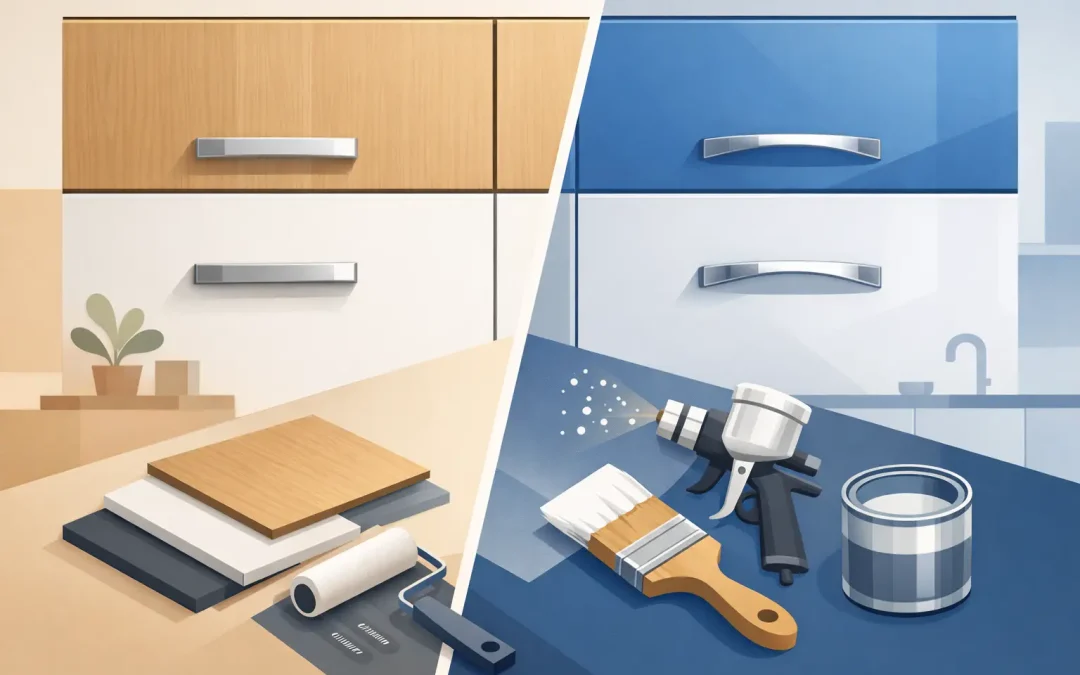
A cabinet finish can change the whole feel of a kitchen – and it also affects how well that kitchen handles daily family life. When homeowners ask about laminate vs polyurethane cabinets, they are usually weighing up three things at once: appearance, durability and budget. The right choice depends on how you use the space, the look you want, and how much value you place on a fully custom finish.
For many Melbourne renovations, this is not a matter of one option being better across the board. It is more a question of which finish suits the way you live. A busy family kitchen, an investment property and a high-end custom build may all call for different answers.
Laminate vs polyurethane cabinets: what is the difference?
Laminate cabinets are made by pressing a decorative laminate sheet onto a board substrate, usually moisture-resistant MDF or particleboard. The visible surface comes pre-finished, which means the colour, pattern or texture is already built into the laminate. That gives a consistent result and a wide range of design options, from plain matt colours to timber-look finishes.
Polyurethane cabinets are created by spraying layers of polyurethane paint onto an MDF door or panel, then curing it to form a hard finish. Because it is painted rather than applied as a separate sheet, polyurethane allows more flexibility in shape and detail. It is commonly used for smooth modern doors as well as profiled or shaker-style cabinetry.
In simple terms, laminate is a manufactured surface applied to a board, while polyurethane is a sprayed painted finish built up over the board itself. That difference affects price, design freedom, wear and tear, and how the cabinetry looks over time.
Appearance and design flexibility
If your priority is variety, both finishes offer strong options, but they do so in different ways.
Laminate is known for consistency. If you want a clean modern kitchen with even colour and texture across every panel, laminate performs well. It also offers finishes that imitate timber grain, stone-inspired textures and ultra-matt surfaces. For homeowners who want a contemporary style without stretching the budget, laminate can achieve a polished result.
Polyurethane tends to suit clients who want a more tailored look. Because it is sprayed, it can be colour matched across a broad range of shades. That is useful if you are working to a particular palette in an open-plan home or trying to coordinate cabinetry across the kitchen, laundry and bathroom. It also works beautifully on routed or detailed door profiles, which laminate cannot achieve in the same way.
There is also a subtle visual difference. Polyurethane can deliver a depth and smoothness that feels more custom, especially in satin or gloss finishes. Laminate looks sharp and modern, but polyurethane often reads as a more refined joinery finish when used well.
Durability in everyday use
For most households, durability is where the decision gets more practical.
Laminate is generally very resistant to scratching, staining and everyday wear. In a kitchen with children, heavy use and frequent cleaning, that can be a real advantage. Quality laminate surfaces are hard-wearing and tend to hold up well against knocks from bags, stools and general traffic around the cabinetry.
Polyurethane is also durable, but it behaves differently. A professionally finished polyurethane surface is tough, though it can be more susceptible to chipping or showing marks on edges if it receives a sharp impact. Dark gloss polyurethane in particular may show fingerprints or fine surface marks more readily than some laminate finishes.
That does not mean polyurethane is fragile. In a well-made kitchen, it performs strongly for many years. The main point is that if your household is rough on cabinetry, laminate often has the edge in practical wear resistance.
Moisture matters too. In any cabinet finish, the quality of manufacturing, edging and installation is critical. If water gets into joins, corners or damaged areas, both materials can eventually be affected. A good finish starts with good construction.
Cost and value
Budget is one of the biggest factors in the laminate vs polyurethane cabinets decision.
Laminate is usually the more cost-effective option. Because the material is factory made and applied to the board, it often comes in at a lower price point than polyurethane. That makes it attractive for larger kitchens, full-home cabinetry projects, investment properties or renovations where budget needs to be managed carefully without compromising on presentation.
Polyurethane generally costs more because the process is more labour-intensive. The doors need preparation, spraying, curing and finishing, and the final result depends heavily on workmanship. You are paying not just for the material, but for the skill involved in achieving a smooth, even finish.
That extra spend can be worthwhile when design impact is a priority. In a premium renovation, polyurethane can add a more customised feel that lifts the overall result. It may also be the better fit if you want specific colours or detailed door profiles that suit the architecture of the home.
The better value option is not always the cheaper one. It is the one that best matches your priorities for style, performance and long-term satisfaction.
Maintenance and cleaning
Both finishes are relatively easy to look after, which is good news for busy households.
Laminate is straightforward to clean with a soft cloth and mild cleaner. It does not usually need any special treatment, and because the surface is non-porous, everyday spills wipe away easily. That simplicity is one reason it remains so popular.
Polyurethane is also easy to maintain, but it benefits from a little more care. Abrasive cleaners should be avoided, and high-gloss finishes may need more frequent wiping if you want to keep them looking pristine. Over time, a painted finish may show wear differently from laminate, particularly on high-touch areas.
One advantage of polyurethane is that minor damage can sometimes be repaired or refinished more effectively than laminate, depending on the issue. With laminate, if the face or edge is significantly damaged, replacement is often the cleaner solution.
Which finish suits which home?
The best choice often comes down to the type of project.
If you are renovating a family kitchen and want a durable, attractive finish that works hard every day, laminate is often a very sensible option. It suits modern homes, offers reliable performance and helps keep the project within budget.
If you are building a more tailored kitchen and want flexibility in colour, profile and overall presentation, polyurethane may be the stronger choice. It is especially well suited to homes where the cabinetry is a major design feature rather than just a practical necessity.
There are also cases where a combination works well. Some homeowners choose laminate for internal or secondary cabinetry and polyurethane for feature areas. Others use laminate in laundries or wardrobes and reserve polyurethane for the kitchen or bathroom vanity. In custom joinery, the best outcome is often the one that balances appearance, durability and cost across the whole home.
Laminate vs polyurethane cabinets for Melbourne renovations
In Melbourne homes, style preferences vary widely, but practicality always matters. Open-plan living, growing families and the need for cabinetry that performs across multiple rooms all place pressure on material choices.
Laminate often suits fast-moving family households and contemporary renovations where durability and value are front of mind. Polyurethane tends to appeal to homeowners chasing a more bespoke finish or a specific design statement. Neither is automatically right or wrong.
What matters most is how the cabinetry is designed, made and installed. Even the best finish will disappoint if the layout is awkward or the construction is poor. That is why material selection should always be part of a broader conversation about storage, function and the way the space will actually be used.
At All Quality Kitchens, that is usually where the best decisions start – not with a trend, but with the home, the client and the purpose of the room.
Making the right choice
If you are torn between the two, think beyond the sample board. Ask how much wear the kitchen will get, whether you want a flat or profiled door, how tightly the budget needs to be managed, and how important colour customisation is to the final design.
Laminate is practical, durable and cost-effective. Polyurethane is versatile, refined and highly customisable. Both can look excellent in the right setting.
A well-designed kitchen should suit your routine just as much as your taste. When the finish matches the way you live, the cabinetry tends to keep working – and looking good – long after the renovation is done.
Recent Comments