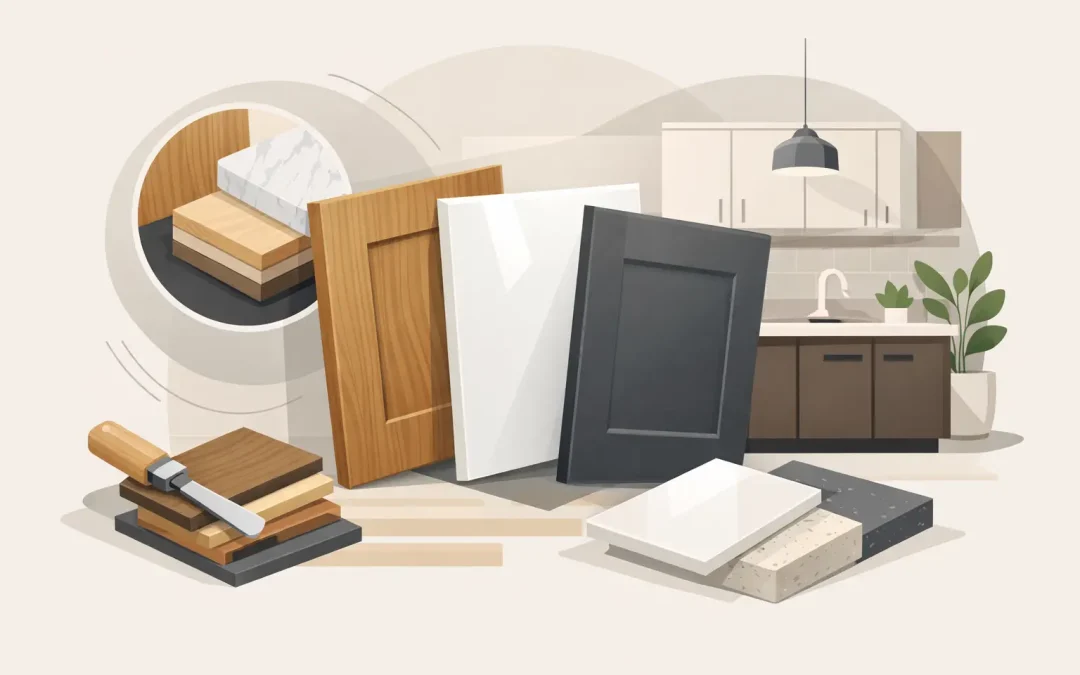
A cabinet door can look perfect in a showroom and still be the wrong choice for your home. In a busy Melbourne kitchen, cabinet materials need to handle heat, moisture, daily use and the occasional knock from school bags, stools or a vacuum. That is why choosing the best kitchen cabinet materials is less about trends and more about how your kitchen actually needs to perform.
For most homeowners, the right choice comes down to three things – durability, finish, and how customised the result can be. Some materials are better for sleek modern kitchens. Others suit painted profiles, warmer timber looks or tighter budgets. The key is understanding what sits behind the finish, not just what you see from the front.
What makes the best kitchen cabinet materials?
There is no single material that suits every kitchen. A family home in Clayton with heavy daily use will have different priorities from an investment property, a compact unit renovation or a high-end entertainer’s kitchen.
The best material is usually the one that balances appearance with long-term practicality. It needs to hold its shape, support quality hardware, resist wear in high-traffic areas and suit the design style you want. It should also work with the way your cabinetry is being built. Custom cabinetry gives you more freedom here, because materials can be selected room by room and panel by panel rather than forced into a standard package.
Best kitchen cabinet materials for cabinet interiors
When people talk about kitchen cabinet materials, they often focus on doors and panels. Just as important is the board used for the cabinet carcass, shelves and internal structure.
Melamine board
Melamine is one of the most widely used materials for cabinet interiors, and for good reason. It is made from engineered board with a fused decorative surface, giving it a clean and durable finish that works well inside cupboards and drawers.
For many Melbourne homes, melamine offers a practical balance of cost, strength and ease of maintenance. It is available in a wide range of colours and textures, and quality boards perform reliably in everyday kitchens. It is especially well suited to modern custom cabinetry where a neat, consistent internal finish matters.
Its limitation is that chipped edges or poor installation can reduce its lifespan. That is why workmanship matters. A well-manufactured cabinet in quality melamine will perform far better than a cheaper board cut and fitted without care.
Plywood
Plywood is known for strength and stability. It is made from layers of timber veneer bonded together, which gives it good structural performance and helps reduce movement over time.
It is often chosen for premium cabinetry projects or where moisture resistance is a higher priority. Plywood can be an excellent option, but it is usually more expensive than melamine and may not be necessary in every kitchen. In many cases, it makes sense in selected zones rather than across the entire project.
Best kitchen cabinet materials for doors and visible panels
Doors, drawer fronts and end panels do most of the visual work in a kitchen. They also take most of the handling, so finish and substrate both matter.
MDF for painted finishes
MDF is one of the best kitchen cabinet materials when you want a smooth painted finish. It has a dense, even surface that paints well and allows for clean profile detailing, making it ideal for shaker-style or routed cabinet doors.
For homeowners who want a painted kitchen in white, soft grey, deep green or another custom colour, MDF is often the preferred base material. It delivers a refined look and can suit both classic and contemporary designs.
The trade-off is moisture sensitivity if the surface is damaged or edges are left exposed. In a properly manufactured and finished cabinet door, that risk is reduced significantly, but MDF still benefits from careful detailing around sinks, dishwashers and other wet areas.
Thermolaminated doors
Thermolaminated doors, often made on an MDF core, are finished with a vinyl surface that is vacuum-pressed over the board. They are popular for their neat appearance, easy cleaning and ability to create both flat and profiled door styles.
This option suits many homeowners looking for a low-maintenance finish at a sensible price point. It is especially useful in modern kitchens where a simple, consistent look is important.
However, heat can be a weak point if the product quality is poor or the kitchen is not properly designed around appliances. Around ovens and other heat sources, correct installation and product selection are essential.
Polyurethane finishes
Polyurethane is a premium painted finish commonly applied over MDF. It gives a smooth, durable surface and allows for custom colours, higher-end detailing and a more tailored result.
For clients who want a bespoke look and are particular about finish quality, polyurethane remains a strong choice. It works beautifully in modern kitchens and can also suit more decorative styles when paired with profiled doors.
It is usually a more expensive option, and like any painted surface, it can show marks more readily than textured finishes. That said, for many homeowners the visual result is worth it.
Timber veneer
Timber veneer gives you the warmth and character of real timber without the full cost or movement associated with solid timber cabinetry. It is created by applying a thin slice of natural timber over a stable substrate.
This makes it a strong option for kitchens where natural texture and grain are part of the design. Veneer suits feature panels, overhead cupboards, islands and full kitchen fit-outs where a softer, more organic feel is wanted.
Because it is a natural product, variation is part of the appeal. It also means every panel will not look identical. For some clients that is a benefit. For others who want complete uniformity, it may not be the right fit.
Solid timber
Solid timber has lasting appeal, but in modern kitchen cabinetry it is usually used selectively rather than everywhere. It offers authenticity, natural beauty and strong visual character, especially in feature joinery.
The challenge is movement. Timber expands and contracts with changes in temperature and moisture, and it generally comes at a higher cost. For that reason, solid timber is often better used as a design feature rather than the default material for an entire kitchen.
How to choose the best kitchen cabinet materials for your home
The right material selection depends on how you use your kitchen, what style you prefer and how long you want the cabinetry to perform without major maintenance.
If durability and value are the priority, a quality melamine cabinet interior paired with durable laminated or thermolaminated fronts can be a very practical solution. If you want a custom painted look, MDF with a polyurethane finish may be better suited. If warmth and texture matter most, timber veneer can create a more natural result while keeping the cabinetry structurally stable.
Budget matters, but so does where you spend it. Not every part of the kitchen needs the same level of finish. In many custom projects, it makes sense to invest more in visible surfaces and high-use zones while keeping internal materials practical and hard-wearing.
Why workmanship matters as much as the material
Even the best kitchen cabinet materials can underperform if they are poorly designed, cut or installed. Cabinet longevity depends on accurate manufacturing, quality edging, moisture-aware detailing and hardware that suits the weight and use of each door or drawer.
This is where custom cabinetry makes a real difference. Instead of trying to force standard units into an existing space, the materials can be selected and built to suit your layout, your appliances and the way you live. A well-planned kitchen will not just look better on day one. It will also wear better over time.
For homeowners renovating in Clayton and across Melbourne, that often means looking beyond a sample board and asking more practical questions. How will this finish handle daily cleaning? Will it suit a busy family kitchen? Is this material right for the area near the sink, oven or pantry? Those are the decisions that shape the final result.
At All Quality Kitchens, material selection is part of creating cabinetry that feels considered, practical and made for the home it sits in. The best choice is rarely the most expensive one. It is the one that gives you the right balance of durability, appearance and value for the way you live.
If you are weighing up options for a new kitchen, start with how you want the space to work five or ten years from now. The right material choice becomes much clearer when it is tied to real use, not just first impressions.
Recent Comments